Latest Entries »

This is the first article in an upcoming series of articles analyzing the status of PC gaming in 2011.

Talks of piracy, development costs, MMO dominance, eastern vs. western markets, the port syndrome, and digital distribution have become all too common as the downfalls and saviors of PC gaming.  Probably the most important factor for both gamers and publishers/developers is undoubtedly cost, and in that regard nearly all of the discussions about the future of PC gaming stem from that.

Cost to develop and publish a product, like in all entertainment industries, must not exceed the profit margin.  That’s simple economics.   What’s not simple economics are the factors involved in collecting revenue in our current PC market space.  Retail games have been steadily on the decline with the advent of digital distribution platforms such as Steam and Direct2Drive.  Production costs are minimized in the digital market, as is the shelf space competition of traditional brick and mortar, and to a lesser extent online warehouse retailers.

Quarter year sales aren’t quite as important in the digital market since the games will have a long shelf life. In addition, older titles can be (and are) discounted as part of a sale.  The downside to this is the expectation for big 50-75% off sales that gamers, myself included, have come to expect from the big digital distribution platforms.  In the process of fueling sales and demand through temporary slashed prices publishers ‘train’ gamers to wait for but price cuts.  Big bundles including an upwards of 20 games are offered for less than the cost of one recently released title at full price.  Several people I’ve spoken to have amassed huge collections – think 100+ games – primarily through such sales.

This strategy of digital sales is not unlike the one featured in the mobile games market on the iPhone and Android marketplaces.  Whereas $1-2$ seems to be the sweet spot for mobile games and apps, Steam and direct2drive seem to move a lot of software in the $10-15 range during sales.  I have in fact bought games on sale for $5 (after a 75% discount) simply to add to my collection.  Some of the games haven’t even seen the embrace of an installation and test run.

Statistics from digital distribution are unfortunately absent as big companies like Steam and Direct2Drive do not release such information to the public.  Still, if the current retail sales are to be compared with my findings and the nearly 2 million players online on steam at any one time, profits however small, are being made. In the wake of rampant piracy, publishers want every potential bittorent download to becomes a legitimate Steam purchase, even at the cost of marking down the product by 75%

The other school of though in the PC industry is quite the opposite: increase prices to make up for lower sales.  The three big publishers – EA Games, Activision – Blizzard, and Ubisoft – have all launched products in flagship franchises at $60 a pop both at retail and through digital download.  Call of Duty, Splinter Cell, Assassins Creed, Star Craft , and Crysis have been marked out, because of their success and popularity amongst PC gamers, as premium franchises.  Extensive anti-piracy measures have been taken by the companies to protect their products, most of which have been received with ardent rejection and stark criticism by the PC community. Ubisoft’s attempt to keep gamers tethered to an internet connection in order to play several games was particularly unnerving and served as one of the reasons for me skipping out on the latest Splinter Cell and Assassin’s Creed games.

Somewhere between these two polar opposites of $60 juggernauts and $60 twenty game collections there must exist a happy medium where publishers and gamers can coexist happily.  Companies that have traditionally passed aside PC gaming, such as Capcom, have offered more support over the past two years – and in the case of Capcom, promise to improve even more.  Microsoft has made a monumental decision of releasing it’s Flagship role-playing game on Steam, a sign of their intent in seeing the growth of the PC gaming industry as a whole and not just their Games for Windows digital distribution platform.

My one hope is that PC gaming doesn’t devolve into an industry of only  AAA $60 blockbusters and $5 indie games.  Growing hardware sales and increased interest in developing markets will assure that PC gaming will never ‘die’ as some have been quick to point out. Game experiences on the PC platform such as the ever-growing Team Fortress 2, Warhammer Dawn of war II, Star Craft 2, the upcoming The Witcher 2 (so many sequels!)  and Star Wars: The old Republic  stand out for PC users. The PC market is an ever evolving one, and with hundreds of millions of capable computers on the market it’s only a matter of coming up with new ways to harness that potential and make a good profit.

Next topic in the series: PC DLC (download content)

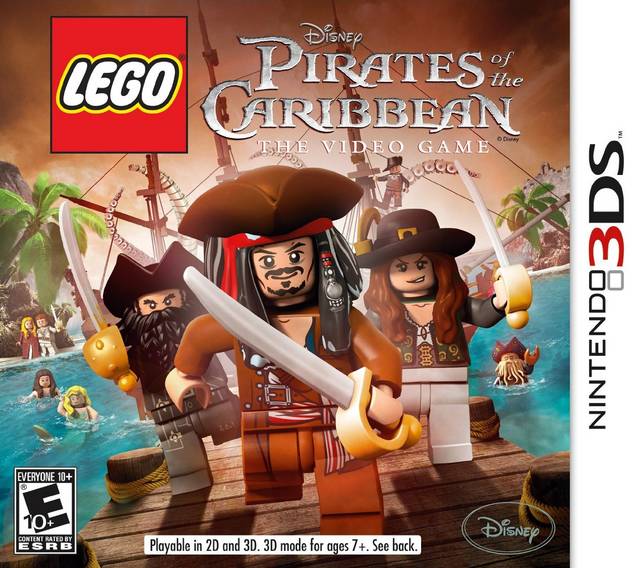
Traveler’s Tales long series of LEGO games has included the likes of several of the Star Wars films, Harry Potter, Batman, and Indiana Jones.  Taking an established franchise, converting it into an action-platformer chock full of LEGO bricks, and mixing in some tongue in cheek humor is the idea here.  Most of the games are fairly good if not derivative of each other, and in that respect LEGO Pirates of the Caribbean is no different for – better or for worse.

LEGO and the Pirates brand are actually very intuitively combined into an action-platformer.  All three of the released films are in here as is the upcoming fourth film On Stranger Tides, set to release in a few weeks.  The goofy and charismatic Johnny Depp as Captain Jack Sparrow translates perfectly to a LEGO game and arguably is one of the most humorous LEGO characters to date.  Unfortunately, as with all of the LEGO games, a prior knowledge of the films’ events and characters is almost mandatory for any of the game’s story to make any sense considering all of the characters speak through  mumbles and grunts without subtitles of any sort.  Its very charming in its own right, but can come off as somewhat exclusive of those not familiar with the series.

A Pirate’s Life for Me

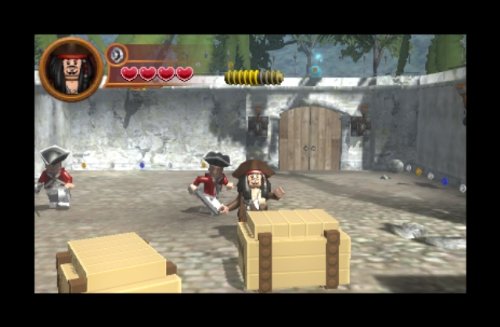
Gameplay is fairly standard LEGO fare, if you’ve played any of the other Traveler’s Tales LEGO games then this will be very familiar to you.  For better or for worse, the game sticks to the series staple of going through several sets of short to medium length levels while collecting LEGO studs to unlock new minifig characters and other goodies. Pre-rendered cut-scenes summarize the four films’ stories and are taken from Xbox 360 and PS3 versions of the game.  A central hub level allows the player to use their collected LEGO stubs to buy new outfits, accessories, and minifig characters, of which there are over 70.

The platforming elements are light and the combat easy throughout the adventure’s 16 levels, which are broken up into 4 chapters based on the films.  Sword-fighting is a fairly easy affair, you can swing a sword or fire a ranged weapon to make short work of baddies.  Short work being the key word here considering the incredible ease of defeating the enemies.  Most will take a few slashes with your sword or two shots with your pistol to finish off.  What’s more is that if you so happen to find yourself out of health you simply re-spawn while loosing some LEGO stubs. It’s probably worth noting that  I did not find myself dying in combat at any point in the game.

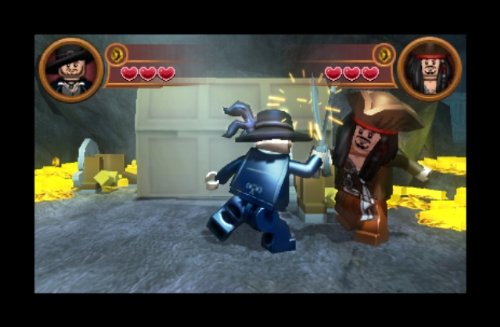
Boss battles are handled through duels and take a cue from Sid Myers Pirates! – released on the PC, Xbox, and PSP a few years ago. Dueling  involves mashing the B button to build up an onscreen gauge and following several on-screen button prompts to successfully land an attack on the boss.  The duels don’t get much harder as the game progresses, leaving the boss battles with much to be desired. Duels aside, the simple combat and platforming allow for very accessible controls- namely the four face buttons controlling the various actions and the shoulder buttons swapping characters.

All in all, the game should take about 6 hours to play through the first time around if collecting the various LEGO stubs and treasures along the way.  Not every character can access every part of the level so a second or third play-through of each level is almost mandatory if you want to see everything that the game has to offer.  That said, it feels more like a leisurely stroll in the park rather than a full on roller-coaster ride – especially if you aren’t in the suggested age category of  10+ .

Sights and Sounds out Yonder.

Traveler’s Tales did a great job in capturing the look and sound of the Pirates franchise in this latest LEGO installment.  The 3DS version of the game is visually akin to the PSP one albeit with much better lighting and shadow effects.  Will Turner, Jack Sparrow, and the rest of the cast are very well animated, particularly Jack Sparrow’s trademark swagger.  Textures can be blurry in certain places but overall are crisp and clean.  The 3D effect is not as pronounced in some places due to the isometric camera angle but is still fairly decent throughout. The 3DS version has less detail than the Wii version yet boasts some very nice real time shadows and lighting.

The excellent soundtrack from the films makes the action sequences more exciting and the platforming more immersive though at the cost of being somewhat repetitive. You will here the roaring pirates theme alot -which isn’t necessarily a bad thing.   The sound effects are fairly similar to he previous LEGO games and involve  a lot of grunts, mumbles, laughs, and the sound bricks being assembled.

Another LEGO Brick on the road of life

One absent feature from the 3DS – and the PSP and DS – version of the game is the coop multi-player.  Instead, Treaveler’s Tales implemented a Street Pass battle feature where you can level up characters by participating in random battles with other 3DS gamers with Street Pass enabled and a copy of the game.  These duel battles have take no input from the player and are simply resolved based on the characters stats.   It’s a neat little feature, though is likely to not get much use, depending on where you are located.  A proper coop mode over the internet would have added a lot of replay value to the relatively short LEGO Pirates of the Caribbean. 

Lego Pirates of the Caribbean is a fairly good action platforming romp on the 3DS for fans of the films and younger gamers in general.  Those looking for more substance in gameplay or innovation to the established LEGO formula would do better to pick up LEGO Star Wars III for Xbox 360 or Ps3, as LEGO Pirates for the 3DS might not sustain your interest for too long.  The action and platforming elements are decent if not overly easy and derivative of past games; though a strong visual and audio presentation, coupled with some great charm and character, does help to look past the games simplicity.  LEGO Pirates of the Caribbean is worth the purchase for 3DS owners looking for some light action-platforming on the go.

Pros

 – Great graphics and Sound

 – Lots of stuff to collect

 – Charming LEGO gameplay

Cons

 – Short

 -Easy and somewhat shallow gameplay

Overall: 7/10

The laptop market has largely been dominated by a few 1000 pound gorillas for the past 10 years, though it’s nowchanging.   Dell and HP have tried to maintain their dominance as brands like Apple and ASUS exploit new opportunities in small and light laptops and – in the case of ASUS, affordable portable gaming computers.  Where does that leave Acer, a company known for a long time as a discount brand?  After purchasing Gateway and integrating some of their notebook designs, the company is slowly changing their image in the PC notebook industry and the 13.3″ Aspire TimelineX 3820TG-6829 is a testament to the brand’s transformation.

At about 4 pounds and less than an inch thick, the 3820TG model line is clearly targeted for mobile power users who need fairly good specs under the hood but in a fairly small form factor.   Having both performance and portability at $800 certainly makes the 3820TG an attractive choice for road warriors .  Usually, laptop manufacturers will have to decide between looks and features/performance when deciding at what price range to sell the computer.  Acer has a notorious track record for abandoning both for the sake of a low price point.  While the 3820TG is certainly not in the league of what Apple or Alienware are putting out in the sub-notebook market as far as aesthetics or bleeding edge innovation, it’s certainly a huge improvement over what they were doing  a few years ago.

Aesthetics and Construction

The Chassis is plastic yet painted in a brushed aluminum style that looks very good, and aside from a few large stickers and a standard black plastic bottom, looks like a more expensive product.  The standard 6 cell battery is completely flush with the casing and plugs into the back of the system. The touch pad, like the battery, is completely flush and features a single button for both right and left mouse clicks. It looks good and works well.  In addition to the standard scroll arrows built into the touch pad, Acer incorporated a new style of scrolling where you rotate your finger in a circular fashion to scroll through pages.   It’s an interesting and useful input method, akin to the scroll wheels found in the older iPods, but still not as accurate as a scroll wheel found on a standard mouse.

The keyboard is unfortunately not the standard one found in most laptops, the keys are spaced apart slightly and it does take a little time and effort to adjust, particularly when hitting the return key.  Still, it isn’t too different and really not too big of a deal once you get a used to it. The particular model I purchased was bought from a Canadian website and features an English and French bilingual keyboard. Oddly this particular model is not available for purchase in the United States and must be imported.  It’s quite puzzling why Acer would keep a good product out of a major market.

Good looks aside the chassis certainly does feel like a sub $800 product.  The computer tends to creak slightly when any sort of flex is applied to the chassis, it’s certainly not as bad as some of Acer’s past laptops but can be noticeable.  The good news for internal components is that the system features a dual fan design the surprisingly keeps the small computer relatively cool during normal use.  The downside to this is that it’s at the cost of the fairly standard optical drive; although some, myself included, would say that in 2011 an optical drive is much less of a requirement than it was say five years ago.

If any one thing has suffered from the affordable price point it’s the screen.  The glossy 13.3″ 1366×768 LED display is quite bright at the maximum brightness level but has poor contrast level, color vibrancy and viewing angles.  The the vibrancy can be remedied to an extent using the ATI display control panel when using the dedicated graphics; unfortunately it doesn’t look quite as good with the intel HD graphics enabled.  Overall, the display is serviceable enough, particularly when considering the machine’s price-point.

Specs:

Windows 7 Home Premium 64 bit

13″ 1366×768 screen

Intel Core i5 480m 2.93ghz turbo boost

ATI Radeon 6550m 1GB Graphics/ Intel GMA HD Hybrid Graphics

500 GB Hard Drive

4GB DDR3 Ram

Wireless B/G/N + Bluetooth

3.97 pounds without charger

12.7 x 9.25 x 0.86~1.14 inches

1 Year Acer Warranty


Performance

Acer may have a ‘bottom of the barrel’ reputation, but that hasn’t stopped them from cramming beefy hardware into this 13″ chassis; namely the Intel Core i5 480m processor with turbo boost up to 2.93ghz, and a mid-range ATI Radeon 6550m graphics card.  The processor is at the high end of the sub-notebook category and the graphics card is perhaps the most powerful seen yet in a 13″ form-factor. The closest direct competitor in terms of performance is the Alienware m11x 11.6″ sub-notebook (Intel core 2 duo @1.73ghz and Nvidia Geforce GT 335M), which will be baseline comparison for the benchmarks scores. All of the following benchmarks were run using the dedicated graphics card with the ac adapter plugged in.


PassMark is one of the most popular software for benchmarking various PC components. It comprises of several CPU tests like video encoding and image editing along with windows browsing, graphics performance, and hard disk read and write speed.  The 3820TG performs admirably with more than double the CPU performance and a much higher overall PassMark score.

The venerable 3DMark06 is now several years old but still remains to be the premier benchmark for video cards, especially mid-range cards featured in most laptops.  Both the 3820TG and the M11x ran the test at 1280×768 resolution with default settings.  The 3820TG’s CPU score is double that of the M11x and in line with the PassMark results.  The overall score is a good bit higher, though some of that is attributed to the much faster i5 processor.  In comparison a desktop Radeon 4850 scores about 13000 3Dmarks at the same resolution.  Still this is a VERY good score for a 13″ laptop and amongst the highest for the category average.

Crytek’s 2007 blockbuster Crysis punished even top of the line desktop computers at it’s release.  4 years later it is still considered to be one of the most graphically demanding and good looking games on the PC platform.  The benchmarks for crysis were run with all settings on high in DX9 with a 1280×768 resolution – as opposed to the native 1366×768 – on order to achieve a more playable frame rate.  Due to both a slightly slightly Radeon 6550 and the exponentially faster core i5 processor, the 3820TG did a better job at running the game while maintaining most of the gorgeous eye candy.  A few of the settings, like shadows for an instance, can be brought down to medium to make for a very smooth 30+fps.

If Crysis made graphics cards weep at it’s release then Rockstar’s GTA IV comparatively made processors weep upon release.  Requiring tremendous CPU power to render it’s giant city, the game makes for a perfect test of the 3820TG’s speedy core i5 chip.  The game was run at 1366×768 resolution with visual distance and detail set at 1 and vehicle traffic set at 27.  Even when increasing the distance and detail levels during game-play the 3820TG managed to keep up with the workload while the M11x displayed unplayable frame rates.

THQ’s real-time-strategy Dawn of War II presents a good mix of both graphical and processing requirements.  With tons of units and explosions on screen the 3820TG pulls ahead of the m11x thanks due to its superior processor.

Battery Life

Battery life is perhaps one of the most important features of a 13″ notebook and with a 6cell 6600mah battery the 3820TG largely delivers  – though not the advertised promise of 8 hours.  In light real world usage – think browsing, word processing, occasional Youtube video – the machine will last around 5 and a half to 6 hours on Intel graphics using the balanced power profile.  Once switching over to the dedicated graphics card and turning up the processor to high performance, you will be lucky to see one hour of gaming.  There is of course a balance between these two but in either case the 3820TG won’t last as long as the M11x or even an apple Macbook Pro 13″.  Acer does sell a 9-cell high capacity battery if your are willing to deal with some added weight and the extra plastic sticking out at the bottom than it may be a good choice for road warriors and frequent fliers looking for more battery juice.

Cooling

Acer’s double fan cooling design allows for a quieter notebook by keeping both fans at low speeds as opposed to one fan at a high one.   Long video editing and processor intensive games such as Grand Theft Auto IV can cause the fans to rev up to a high speed  as the CPU reaches 80 degrees Celsius – a safe temperature, but one that ideally should not be maintained for too long.  The graphics card tops out comparatively low 72 degrees Celsius. The thermal management is thus fairly efficient, especially when you consider the 3820TG’s small 13″ frame.

Conclusion

The Acer 3820TG is a great, if not perfect, mid-range 13″ sub-notebook.  You get a great value and fast performance while only having to make a few concessions on the screen and, speakers, and the less than stellar build quality.  For professionals and gamers alike the machine has little if any direct competition.  That said, the competition may be much easier to find as Acer unfortunately did not release this particular model in the States.

Price as Reviewed: $750 CAD

Pros:

+ Pleasing aesthetics (south of an apple product)

+ Fast processing / gaming performance

+ Great Value

Cons

Not available in the United States

Less than stellar build quality

Poor Screen contrast

Overall:   B+


Game of Thrones TV Pilot

HBO aired today its brand new fantasy show Game of Thrones, an action drama starring Sean Bean of the Lord of the Rings fame. Clocking in at a little over an hour, the series’ premise is kingdom strife with political instability and intrigue; and aside from a well done intro sequence suggesting some fantastical elements, little else.  Overall well done acting and costume design is marred by an uninteresting plot, predictable characters, and blatant sexism and racism.

Although billed as a fantasy drama, the first Game of Thrones episode spends much of its time introducing as many fairly mundane characters as possible without giving us a reason to really care about too many of them.  In fact Showtime’s The Borgias, another medieval era drama, chronicles the rise of the very real Borgias family to the papacy (pope-hood) of Rome, and features more action than Game of Thrones, a show with burly men with over-sized wolf pelt coats.

The show seems to follow Ned Stark, played by Sean Bean, and his invitation to serve the king of the land as his right hand man.  His two sons and wife must deal with his decision and their place in it – whatever it may turn out to be.  Other Characters include a brother, Prince Viserys Targaryen III, and sister, Princess Daenerys, who are estranged from their homeland and must amass an army through a political marriage to reclaim their lost Kingdom. So it stands to reason that this must be facilitated through a union with a stereotypical savage – read minority – and essentially involving rape. It  can potentially sour some of the appeal of the show to certain people.  The sexualization of women doesn’t come off as a historical detail as it does in The Borgias, but as a strong attempt to sell sex to a largely male demographic. It’s all very confusing to boot.

The issues mentioned so far sour the experience but don’t  make the show completely unwatchable.  There are several great moments which immerse you into the world and give a sense of what life is like in the different kingdoms of the world, even if some of it is based on stereotypes.   If the show can capitalize on some of these nuances, bring more of the excellent visuals, and make us truly care about it’s characters then the show would be better for it.

Of all the recent hit dramas including Dexter, Mad Men, Breaking Bad, The Walking Dead and The Borgias, Game of Thrones had the weakest pilot episode.  If you’re a fantasy fan it may be worth checking out, just don’t expect the rest of the Lord of the Rings crew to join Boromir.  If not, then the show is probably a pass as the characters can’t seem to hold the weight of the premise of a ‘realistic’ high fantasy setting enough to really be cerebral and provocative.  Then again, who knows, the show may catch its stride at some point.

Splinter Cell 3d for the Nintendo 3DS is a port of 2005’s critically acclaimed Splinter Cell: Chaos Theory.  The story is the same, the levels are all here, but the gameplay is merely a reflection of the original in a dirty pond.  With some 3D effects.  for $40.

You are Sam Fisher, a Black Operative for the ‘Third Echelon’ division of the NSA – all very under the radar top secret stuff.  You are tasked with finding out why a rag tag bunch of revolutionaries in Peru stole top secret computer algorithms.  Naturally the even is connected to North Korea and China, and the story unfolds through news reels and cut scenes throughout the  game.  The story itself is fairly decent although minimal, this isn’t Metal Gear, and at least it isn’t so convoluted.

Due to the one man nature of the mission, Fisher’s success depends on stealth as opposed to run and gun tactics found in most shooters.  To avoid detection you stick to the shadows and either shoot unwitting grunts in the head with your silenced pistol or get up close and personal to interrogate, knock them out, or kill them in close combat.  The latter two are easy enough due to simply running up to an enemy and pressing one of the triggers.  The former can be a pain in the rear -for both parties involved – as you must use a contextual button on the touch screen when you are behind the enemy.  I found myself often nearly touching the grunt with no grab command coming up on the screen.  It can be frustrating to say the least.

Other aspects of the controls are fairly well done considering the lack of a second analog stick.  The circular pad moves Fisher while the face buttons are used for camera control.  The touch screen gives you access to switching weapons, looking at the map, and turning on the all in one enchanted vision goggles.  For a first person shooter the touch screen would have been more ideal for camera aiming, but given that this is a slower paced stealth game the face buttons usually work.

The iconic green glowing vision goggles are back although gone are the different vision modes found in the previous versions of the game.  Instead what we have is a generic white and gray vision mode that highlights anything of importance white.  On one hand it streamlines the gameplay consolidating them all in one function for ease of use.  On the other hand it’s fairly bland and boring. If playing in an area of low ambient light you shouldn’t need them anyways.

The level design is perhaps one of the worst aspects of the game; detailed continuous levels found in the original Xbox and PC versions of the game are replaced by broken up into sections of usually bland ones on the 3DS.  Some fare better than others though the very first in particular, is quite hideous and dull.  The original’s levels felt like real places as opposed to corridors that simply connect level segments.  You get from point A to point B while taking out enemy NPCs of dubious  A.I which aren’t an inquisitive bunch, and will stick to limited paths in the levels. With all of that being said, there is a good amount of content in the game, with about 10 levels filled with both primary and secondary objectives.

The problem of level design is exacerbated by the graphical presentation as a whole.  Ubisoft seemingly rushed the game out of the door with tacked on 3D visuals and a very low framerate.  The game isn’t very detailed and considering the simple level design it’s hard to understand why the framerate is in the 20s most of the time.  The controls may themselves be decent, but when the game begins to chug during shootouts, you will have a hard time aiming.  The 3D effect is quite good, especially in some of the later levels that have a bit more detail, just don’t expect to see it if playing in an environment with too much ambient light.

With the 3D turned on Fisher stands in the foreground  while the levels and enemies remain in the backround. Objects such as rails and boxes sometimes pop out though it can be difficult to see depending on the level.   Ubisoft also included on screen hints in white and red letters – similarly to what they did in Splinter Cell Conviction – that pop out in 3D mode.  It’s pretty neat, just not very useful for actual gameplay.

The audio is pretty much ripped from the previous versions albeit with some of the dialogue omitted. The soundtrack is fairly minimal, kicking in at certain times of action such as shootouts.  Michael Ironside provides some good voice overs for Fisher with some great deadpan humor on the side.

Chaos Theory on the Xbox and PC was known for it’s robust multiplayer component.  Both the coop and versus modes are completely absent from the 3DS version, and probably for good reason: the 3DS version is simply too slow for any kind of multi-player to be enjoyable.

If you’ve played Chaos Theory before on the PC or Xbox then this version will probably disappoint you.  Then again if you are a die hard splinter cell fan then…. you probably should still stay away unless you want to see your beloved spy  in a ‘shadow’ of his former glory.  If you absolutely need something to play on the 3DS and you can find this in the bargain bin then it may be worth it so long as your expectations aren’t too high. It can be fun at times, but the shortcomings can’t justify spending more than $20 for some so so stealth action on the go.  Hopefully Metal Gear Solid 3 will do more justice to stealth games on the 3DS when it’s released.


Pros:

– Port of a classic stealth action game.

– Plenty of single player content

– Good implementation of 3D

Cons:

– Hit or miss graphics.

– Low frame rate + slow controls

– No multi-player of any kind.

Score : 6.5/10


According to sources, revealed IGN.com today, Nintendo is planning on unveiling it’s new console during this June at the e3 entertainment expo.  The sources have speculated that the Wii’s successor could be released at the end of 2012.

So there you have it folks, we might be seeing the end of the world, but at least we’ll be doing so with the net gen Nintendo console firmly in hand.  It’s about time really; Nintendo needs to capitalize on their momentum and their competitors supposed ’10 year plan’, to get a good head start in the next generation.

The sources aren’t unanimously agreeing on the Wii successor’s graphical capability, though some claim that it will be significantly more powerful than the Xbox 360 and the Playstation 3.

Given Nintendo’s track record in their past few releases – including their recent 3ds – I seriously doubt that their new console will be ‘significantly’ more powerful than the current HD machines.   The 3DS for an instance, is a great little machine capable of outputting some good looking graphics,  yet it’s still relatively in the same ball park as the PSP.  That’s not to say it isn’t better, but I am saying that the 3DS games shown thus far could certainly work on the PSP sans the 3D effect.

In the same way Nintendo’s next console – which will not likely include 3D TV capability – will most likely set the visual bar slightly above the current HD consoles.  I wouldn’t be surprised if it included something along the lines of a mid ranged ATI Radeon 6570 (i.e. a little above xbox 360 quality) and a quad core next gen ARM processor. The speculation that the system will be backwards compatible does make it a possibility that Nintendo might choose to partner with IBM and ATI again – unless of course the backwards compatibility will be achieved through emulation.  Totally plausible, yet somewhat unlikely considering the poor jobs both Sony and Microsoft have done with backwards compatibility on their current systems.

Given the graphic fidelity of Sony’s upcoming NGP, Nintendo certainly won’t want their flagship console to be out shined by a handheld.  The Wii successor will almost certainly have better graphical capabilities than the NGP.

Cost will also be an important factor as Nintendo favors having the cheapest hardware on the market.   I can’t see Nintendo  developing a proprietary powerhouse CPU like Sony’s cell; we should see their next console go for relatively less than what the HD consoles went for, about $300 at launch.

I’m guessing Nintendo will not drop the wildly successful motion controls from it’s next system in the same way they did not exclude the touch screen from the 3DS.  They will obliviously expand on the technology somehow, though it will likely not be an imitation of Microsoft’s Kinect.

While on my quest to find the ultimate handheld gaming device, I decided to go down a different avenue than the manufactured hardware most of us usually buy: I wanted a homemade “portibalized” console.

Now I’m certainly no slouch when it comes to electronics repair – sans soldering of course – but one quick look at the guides posted online on the portable video game hacking cite Benheck.com  made me reconsider my abilities and dampened my prospects of making my own portable console.  Still intent on owning one, I found a respectable modder whom I commissioned a portable GameCube from for about $750.

Yes that’s right, $750 big ones.  As shocking as it may sound, this is is the standard figure for a good looking portable GameCube.  Most of it going to cover the labor costs as opposed to the actual hardware as a GameCube system can be found on eBay for around $30.  The other big contributor is the screen and case, the former usually being an out of print PS1 LCD screen and the latter being  molded plastic or CNC (computer numerical control) cut plastic/MDF wood.  My particular ‘cube was to be cut on a CNC machine – which can go for an upwards of a thousand  dollars or more to buy or build yourself.

I chose the GameCube not only because I’m partial to Nintendo games, but also because the PS2 slim is already fairly portable with a very nice attachable screen, an Xbox is simply impossible to shrink down, and the other older consoles are capable of being emulated on other handhelds.  Being a true Zelda fan at heart I couldn’t help but be excited at the prospect of playing Twilight Princess or Wind Waker on a portable.

Because of space inside the unit and monetary constrains I could only have a 2500mah battery included, which roughly translates to about an hour battery life.  Still, an hour of my favorite Zelda game on the go would be worth it; unfortunately things didn’t work out that way and in the world of portable consoles that is simply a part of the deal.

I received the GameCube from overseas about a month after the project was commissioned.  It’s pretty incredible to see a full-fledged console squeezed into such a small form factor, and despite its size compared to a Nintendo DS I was extremely impressed. Aesthetically, the GameCube looked almost like a manufactured product, albeit a little rough around the edges.  Ergonomics aside it felt great playing Twilight Princess for the little time I had it.    Unfortunately the impression did not last and the unit immediately fell prone to constant disk read errors and the battery refused to charge.  To add insult to injury the memory card did not work and one of the triggers wouldn’t register being pressed.  Cue the massive disappointment.

Having browsed through the forums I knew that there could be a few issues somewhere down the road; what I didn’t know is that I would get them so quickly.  Portibalizing requires a lot of modification of internal components, which increases their chance of failure in the process.  Compounded with using hardware that likely has seen several years of use, these issues make it difficult to really own a portable GameCube and even more difficult to justify spending $750 bucks — especially if you really have no idea how to fix it.

Some of the older hardware like the SNES or the N64 probably makes for better portables considering they have less moving parts, thus fewer variables to break.  It doesn’t hurt that the parts for the older consoles are so easily acquired on eBay. So if you have the technical know-how to attempt at making your own portable then making and owning one is easier due to your ability to maintain it should something go wrong.

Especially with something as advanced as a GameCube or PS2, I wouldn’t advise anyone to spend large amounts of money on buying one, and even building one can become prohibitively expensive.  Sometimes it’s not even a matter of skill and the quality of workmanship – although that can contribute greatly – as it is a simple fact that the homemade hardware  has a much greater chance of failure than your typical manufactured console.  Of course Red Ring of Death affected Xbox 360’s need not apply – although it’s worth noting that Microsoft will gladly fix your console or send you a replacement.  It’s much harder to do that when your homemade handheld console is one of a kind and needs to be shipped halfway across the world to be repaired.

Ah well, there’s always the 3DS.

Thousands of brave men and women – and a few, hopefully, supervised children – braved the weather and fierce competition to get a Nintendo Wii at launch.  I was amongst such a crowd for over eight hours at the Nintendo World Store in New York City.  One year later.  That’s right, a year later the system was sold out everywhere and was going for an upwards of $400-$500 on eBay.

While it’s certainly not Christmas time right now, the 3DS simply isn’t flying off the shelves.  It’s certainly reasonable to assume that if the demand for the system is exceeded by the supply, prices will remain fairly close to MSRP near launch.  The thing is, brand new 3DS’ are consistently going for $225-$230 including shipping.  That’s with buy it now prices, auctions can sometimes be even lower.

Now granted retailers make up the vast majority of 3DS sales yet one can’t quite grasp how so many are available at nearly $25 off MSRP.  When you factor in sales tax it can be closer to $40-50 off of MSRP. When you factor in shipping cost plus eBay fees, an eBay seller would receive something like $210 for the 3DS.   Sites like Craiglist also offer a plethora of people offering to sell new 3DS’ for sub-retailer prices.  Is Nintendo selling the 3DS to retailers for a lower cost?  If so why? Even sales of games must be low considering Amazon is offering a $10 coupon after purchasing a 3DS game – excluding a few such as Samurai Warriors for some reason.

Somehow I feel that the 3DS might not be as much of a success as the original DS was, and in fact still is.

I’ve recently bought an aftermarket black 3DS silicon case off of ebay in hopes of keeping my 3DS protected whilst not sacrificing portability.

There are about three or four different aftermarket case designs going around right now, most of which come from Hong Kong.  Prices vary depending on the location of the seller and I chose a slightly more expensive one from a US seller in hopes of getting it quicker than one normally would get directly from Hong Kong.  With shipping the total came up to $6.50.  Cheaper ones were available from outside of the US for about four bucks.

Silicon cases are quite popular for phones and ipods/mp3 players though ergonomically those devices are quite different from Nintendo’s 3DS.  Where as an iPhone is a one piece device with no face buttons, the 3DS sports a two piece clam-shell design and several buttons and an analog stick.  The silicon case doesn’t interfere much with the usability of an iPhone.  The 3DS is another story.

The black silicone case covers up the 3DS’ buttons and d-pad which forces you to press silicone buttons instead of the devices plastic ones.  It’s not really terrible, but it’s certainly not good either.  The excess rubb
er connecting the top screen to the bottom of the unit  hangs out on the back when the device is open and sometimes interferes with pressing the triggers. I ended up cutting off these straps altogether as they served little purpose and really bothered me during use of the device.

The top of the case doesn’t meld well with top screen as there are no holes to accommodate the 3DS’ top screen rubber bumpers – I had to cut small rectangles out to allow some room for them.

Once I worked everything out the case seemed alright for protecting the 3DS against minor things like scratches and scrapes. Being that as it may it’s just disappointing when you have to cut holes in a BRAND NEW product designed for a particular device.  It’s as though the manufacturer cooked the case up in a matter of hours without properly testing it and shipped it out for new 3DS owners to get ripped off with.

If you can find one of these for one or two dollars and are willing to snip and cut to accommodate your 3DS better then this may be worth getting, otherwise I’d stay far far away from this junk.


As of Sunday March 27th Glasses free 3D is here courtesy of Nintendo’s new 3DS handheld video game system – the question is, should you go out and buy one?

The 3DS is Nintendo’s successor to their exuberantly popular DS system which was released back in 2004.  Including the original’s innovative touch-screen, the 3DS adds a stereoscopic glasses free 3D screen to enhance the graphics in eye-popping 3D.

To get it out of the way I can safely say this: The 3D effect works, and fairly well at that. That said 3D alone is not enough to make a good system.  Is the $250 price justifiable?

Many Nintendo fanatics and technophiles have already plunked down their cash and became early adopters of the handheld gaming device; though if Nintendo is to have their way many more will experience the handheld sooner or later.  The caveat is precisely that: sooner or later; and there are several things to consider, including price, software, and of course 3D itself, before you decide if you should purchase a 3DS.

The Hardware

The first thing you’ll notice about the 3DS is how strikingly similar it is to Nintendo’s DS Lite and DSi systems.  The chassis – which is available in black or turquoise – sports the same dual screen configuration and clamshell design, albeit with a slightly different button layout.  The top 3D stereoscopic screen measures at 3.53” with a resolution of 800×240 (400×240 per eye) while the bottom touch-screen measures at 3.0” with a resolution of 320×240.

The device measures in at less than an inch in thickness, .83” to be precise, weighs about half a pound and is roughly the same size as a Nintendo DS Lite.  Although being somewhat bigger than your average cell phone or iPod the system will easily fit in a pocket or small purse.

The device has four face buttons, a directional pad, and analog nub (called circular pad), a pair of triggers, a slider to control the depth of the 3D effects, a volume slider, and start, select and home buttons.

The face buttons and triggers follow the same layout as the Nintendo’s previous DS systems albeit noticeably smaller.  People with small hands may not mind the small nature of the buttons though those with larger hands may find the button layout a bit cramped. The directional pad in particular is quite bad.

The analog stick on the other hand has a large circumference and accommodates your thumb quite nicely, much better in fact, than the PSP system, which was notorious for having a small and unresponsive analog nub.

The bad news is that there is only one, a limitation that has hampered the control of certain types of games such as first person shooters on the PSP.  That said, the touch screen can potentially mitigate this issue if implemented in games correctly.  Overall, the 3DS is just not as comfortable to hold as the DS Lite or Sony’s PSP.

The 3D slider, located on the side of the upper half, controls whether the 3D effect is turned on, and if it is, how much depth is used.  When pushed all the way the 3D effect is more pronounced and when pushed to minimum the 3D effect is muted.

The start, select, and home buttons are completely flush on the system and are difficult to press.  In certain cases it took me several tries to apply enough pressure on these buttons to use them properly.

The included stylus fits snuggly inside the system and is fairly comfortable to hold.  Two Cameras in the back are capable of taking 3D photos and the lone camera in the front takes 2D ones.  Don’t go throwing out your digital camera though; the two cameras are only 0.3 megapixels (640×480), which is worse than many cell phones.

Thankfully the 3DS has better sound quality than most cell phones, which is an improvement over the original DS and DSi. The volume itself is quite loud but if one desired to play without making much noise a standard headphone jack is available as well.

For wireless capability, Nintendo has included 802.11g, which is fairly good for a handheld but not up to snuff compared to 3G/4G found in other (albeit more expensive) wireless devices or even 802.11n found in most current routers.

The bottom touch screen is pretty responsive though it’s a shame it is not multi-touch responsive like the iPhone and some of the newer touch screen devices.  The screen won’t recognize the press of a thumb for an instance – a particular point on the screen must be pressed with the stylus or thumbnail for the 3ds to register the press.

With a price tag of $250 it is disappointing that Nintendo includes what is essentially 7 year old tech for the bottom screen.

The top screen on the other hand is beautiful and crisp, particularly when viewed in 3D, which is of course the main feature and selling point of the system. The 3DS sports a pretty capable graphics chip to take advantage of the 3D capabilities; close to the Nintendo Nintendo Wii in capabilities but certainly not up there with Sony’s upcoming NGP handheld system.  Now whole it won’t give you PS3 or Xbox 360 level of graphics it will provide enough graphics power for something those systems can’t do: glasses free 3D.

Glasses-Free 3D

The 3D effect truly is revolutionary when you consider that those annoying glasses required for viewing 3D televisions and movie screens are not necessary. The fact that this is true on a handheld makes the 3DS something of a technological miracle – well almost.

The 3D depth slider on the side of the device controls the depth of the 3D and whether it’s on or off.  Some people report that the 3D effect gives them head-aches and makes their eyes feel uncomfortable.  I personally have not experienced any of these issues even when playing with the 3D depth slider set to the maximum level possible.

Others might have the trouble focusing on the 3D and/or get headaches after extended play though this is probably rare.  Never the less if you find yourself feeling sick after viewing a 3D movie at the theaters or with a 3D television, you may have to limit yourself to using the 3DS in 2D mode.

That is of course not to say that the experience of viewing the 3D is just like the one with your standard 3D requiring glasses. The effect is similar, albeit somewhat subtler, as the 3D doesn’t leap out at you as much as it gives you a real sense of depth, like looking out of a window.

The downside to the glasses free experience is that there is a particular angle that the 3DS must be held at to see the 3D effect clearly; move just a little to the right or left and the top screen becomes blurry and you lose the effect.  Fortunately you don’t have to fine tune the angle for more than 1 or 2 seconds at most and the adjustment shouldn’t interfere with gaming – unless perhaps you attempt to run or jog while playing, then it may become problematic.

As with most electronics, the more advanced the hardware, the shorter the battery life.  The 3DS is no exception and the 3D experience unfortunately takes its toll on the portability of the system.  On a full charge and with the 3D and Wi-Fi turned on and brightness set to maximum, the 3DS only manages to muster up about 3 hours of play time.

At minimum brightness and no 3D or Wi-Fi the system can give 4 ½ to 5 hours depending on the game.  That’s particularly disappointing when compared to the Nintendo DSi’s battery life of about 15 hours on minimum brightness.  Still it’s comparable to the PSP’s battery life and is certainly doable.  Nintendo includes a charging dock to keep your 3DS in while it’s charging  though to me it comes off as cheap and largely unnecessary.

It’s also worth noting that Nintendo recommends that the 3D effect not be viewed by those less than 7 years old, though I personally wouldn’t recommend giving a $250 device to a toddler regardless of the possibility that the 3D may burn holes in their eyes.

The 3D itself is pretty much just as Nintendo promised.  It really does enhance the gaming experience so you should drop this article and go run heedlessly to buy one right now right? Well… it’s not as simple as that.

Though Nintendo introduced this revolutionary tech it by no means has exclusive rights to it.  Within the year more manufacturers, almost certainly including apple, will integrate the glasses free technology into their own devices.   What will differentiate the 3DS is the quality software that smart phones simply can’t produce.  Well, hopefully, because right now that doesn’t seem to be the case.

The Software

So perhaps  you’ve bought your 3DS and are dying to test out the 3D.  Even if you don’t have any software purchased with the system you’re in luck: Nintendo includes several 3D games and other software utilizing the 3D cameras built right into the system OS.

Nintendo brought over the wildly popular ‘Miis’ from the Wii console, allowing the facial recognition software to be use the camera’s to approximate your own face, and even allowing you to import your existing Mii from your Wii.  The Miis look and function exactly like they do on the Wii albeit in 3D.

Nintendo Sounds allows you to record and edit sounds and tunes.  Not really a gameplay feature but a cool one to have none the less.

Face raiders allows you to take a profile photograph of anyone’s face and map it to flying balls for some fun shoot-em-up time.  Several AR (augmented reality) games can be played with the 6 included paper cards to use the 3D cameras seemingly blend the real world into a set of mini games.

Both of these games have a definite ‘wow’ factor when first trying them out and showing them to others.  Seeing your face or two-dimensional card come to life is pretty awe inspiring at first, yet grows pretty old after a while.  Both games are great showcase software no but don’t offer much in the way of substance or replay value.  Wii Sports, which was bundled with the Wii console, arguably offered more gameplay, still they’re free and a nice addition to the handheld.

Other software features built into the unit include the Street Pass feature designed for your system to interact with other 3DS systems while walking around. In addition, with the Activity Log, the 3DS keeps track of the amount of steps you take and converts it into coins to purchase / unlock things in certain mini games.    Both features are great though aren’t taken advantage of in most of the launch games.

If you have a collection of DS software, the 3DS is backwards compatible with most if not all.  DS games tend to look fuzzier on the higher resolution screens than the original DS hardware but are still playable – though of course only in 2D mode.  Gameboy Advance carts can’t be used but Nintendo may offer them as downloadable titles along with original Gameboy titles in the future.

3DS games are available in a small cartridge format similar to the original DS, and in the future through Nintendo’s download service.   Of the 16 available launch titles – including the three virtually identical versions of Nintendogs + cats – there isn’t much quality gameplay to be experienced.  Retailing for $40, most of the 16 games are either quick ports or rehashes disguised as ‘sequels’, few substantially justifying a re-purchase to play in 3D on a handheld.

Rayman, Ridge Racer, Samurai Warriors, Pilot Wings Resort, Super Street Fighter IV, Super Monkey Ball, The Sims 3, and Madden are all games we’ve seen countless times before.

What’s more is that many of these games are available – sans the 3D of course – for mobile devices, and under $10.

I’ve spent a considerable amount of time with Super Street Fighter IV: 3D edition and I must say that it is the best one of the bunch despite falling into the same category of being a port.  The game’s graphics and 3D effect are striking and feature set, including online and local play, and street pass functionality which lets you battle out with virtual figures. If you are a fighting game fan and do not own Super Street Fighter IV, this is certainly a fine version of the game and might justify buying a 3DS right now.

That is not to say that all of the other titles are horrible, some like Nintendogs + Cats and Madden are fun if not derivative and shallow.  The problem is that the price of the current games and the system may not justify the purchase so early after release, even if the 3D is quite good.

Nintendo currently does not have a virtual store to buy games directly through the 3DS.  They have stated that an online store will be released at a later date.  I’m confused to the reason for its absence at launch but hopefully they will have it up sooner than later.

The Future of the 3DS

The success of any handheld gaming device or console ultimately comes down to the quality and quantity of the games available.  The 3DS has the potential to become a worthy successor to the DS and one of the better displays of 3D technology.  The problem right now is that none of the games really justify the $250 price tag of admission.

Don’t get me wrong, it’s a great device and truly one that is unique right now in the handheld market.  If you are dying to try out the technology I can say that it is well designed and truly makes the 3DS shine in that regard.  For most though, a video game system is about the games to play on it, and there lies the 3DS weakness as of right now.  Some great looking titles including the Legend of Zelda: Ocarina of Time, Kid Icarus Uprising, and Resident Evil Revelations, and Metal Gear Solid 3 are set to be released this year and would make good candidates for the ‘killer app’ that the 3DS really needs to really succeed.

If reports of the ~$101 manufacturing cost of the 3DS are true then it’s only a matter of time before the console receives a price cut, especially with the proliferation of 3D handheld devices and Sony’s upcoming NGP. At $250 the novelty of the 3D may be justifiable to Nintendo but at around $200 the 3DS would be much easier to recommend.

As it stands now, unless you are dying to experience the 3D tech and/or are completely new to handheld gaming and have never played the various ports and rehashes, you could do well to wait for either a price drop or the release of some of the better games planned for the system.